Just under three years ago, I gave a presentation on the impact of open innovation on the activities of firms within the Cambridge high tech business cluster. In that talk, I made a throwaway comment about whether we'd one day be able to drop the 'open' bit and just go back to talking about 'innovation'. Last week, as I was summing up the key learning points from a module on Technology and Innovation Management for some of our MEng students, the same thought struck me again. As I drew together the key points from each of the sessions we'd covered during the week (the timetable is shown below), almost every theme we covered had 'open' aspects to it. With hindsight it felt a little bit as though having a session explicitly on open innovation was now a bit redundant. But I'm not sure whether this is just a bit of Maslow's hammer in my thinking (i.e. I just see open innovation everywhere because that's how I see the world), or whether we really should be thinking - and teaching - less about specific flavours of innovation, and more about appropriate tools for different tasks.Identify and sharing new ideas and research on how to implement open innovation.
Sunday, January 27, 2013
Is 'open' now redundant?
Just under three years ago, I gave a presentation on the impact of open innovation on the activities of firms within the Cambridge high tech business cluster. In that talk, I made a throwaway comment about whether we'd one day be able to drop the 'open' bit and just go back to talking about 'innovation'. Last week, as I was summing up the key learning points from a module on Technology and Innovation Management for some of our MEng students, the same thought struck me again. As I drew together the key points from each of the sessions we'd covered during the week (the timetable is shown below), almost every theme we covered had 'open' aspects to it. With hindsight it felt a little bit as though having a session explicitly on open innovation was now a bit redundant. But I'm not sure whether this is just a bit of Maslow's hammer in my thinking (i.e. I just see open innovation everywhere because that's how I see the world), or whether we really should be thinking - and teaching - less about specific flavours of innovation, and more about appropriate tools for different tasks.Sunday, February 12, 2012
Start with open questions: How Cambridge academics are learning the skills of open innovation
Since the late 1990s, UK universities have been explicitly encouraged - and funded - by the Government to develop their 'third missions', i.e. adding 'application' to their traditional two missions of teaching and research. Public funding for universities is now explicitly linked, in part, to their ability to demonstrate the 'impact' of their research activities. One way of helping ensure that research is more impactful is through the engagement of corporate partners throughout the research process, as funders, collaborators and end-users. Or, to put it another way, universities are now positioning themselves as open innovation partners for corporations.
Many universities have set up dedicated groups to help smooth interactions with industry partners, but what has received much less attention is the need to help academics themselves develop the skills needed to identify, negotiate, setup and manage projects that deliver mutual benefit. Though there is an essential role to be played by university research offices, technology transfer, and corporate liaison offices, as successful technology entrepreneurs know, engaging with customers is something that everyone in the organisation needs to be good at. Recognising this, Cambridge University Computer Lab and the Engineering Department recently ran a workshop to help academics develop their skills for setting up industrial collaborations.
The workshop was delivered by a former Cambridge Engineering Department researcher, who has gone on to run several successful manufacturing and service businesses across Europe: getting an engineer to run the workshop helped avoid some of the Dilbert-esque concerns that might have turned-off potential attendees. 38 academics from across the School of Technology signed up to spend a day learning about the process of identifying and working with potential commercial partners to develop collaborative research activities. Basic negotiation and sales skills were introduced, and delegates then spent the bulk of the day practicing these skills through the delivery of elevator pitches and the series of structured role-plays.
Sunday, October 30, 2011
Partnerships between technology-based start-ups and established firms: making them work
Research shows that making such partnerships work can be problematic. However, there are ways to increase the chances of success. Here we indicate some of the problems that can arise – and some possible ways to avoid them. More information on this topic can be found at www.managingpartnerships.net
- Strategy and business model: The start-up is likely to consider multiple possible application areas for its technology. It can greatly assist negotiations if these can be captured in a roadmap that highlights the various opportunity areas and shows the resources needed for implementation. The start-up should also be aware of three possible outcomes of a partnership: it may help to implement the intended business model(s); it may open new opportunity areas; but it may also restrict future opportunities. The large firm should try to create a roadmap or portfolio map that can be shared with start-ups. This should position the large firm’s technology capabilities and needs (including an assessment of the level of criticality) and indicate different opportunity areas. Depending on the level of criticality the large firm may decide to spread risk by having parallel technology acquisition routes.
- The technology: The start-up should make a realistic assessment of the readiness level of its technology and identify tasks and costs associated with preparing it for manufacture – including finding out who owns any complementary resources required. The large firm should use its roadmap to position the start-up’s technology within the broader range of its activities. It should show what complementary resources are needed to bring the technology to market and how this may change over time. It should assess the readiness levels of the start-up’s technology and how much of the technology is tacit (undocumented) versus explicit. The commercial viability of the start-up needs to be monitored bearing in mind how critical the technology is to the large firm.
- Company organisation and culture: Start-ups will find it useful to check whether the large company has ever worked with a start-up before. If they lack large company experience themselves they should seek advice from non-executive directors, mentors or investors. Talking to the large firm’s suppliers can help develop a sense of how the larger company works. It is also a good idea to encourage informal interaction between the teams so that the large firm gets a better sense of start-up culture. The large firm should spend as much time as possible helping the start-up to understand the needs, internal processes and culture of the large firm. Process maps can be used to show start-ups how decisions are made. Some firms use a dedicated team or individual champion to act as first point of contact. This can help shield start-ups from unnecessary bureaucracy and smooth communication in both directions.
- Setting up the deal: The start-up should find out who is likely to influence and authorise the decision to form a partnership. The start-up should have a clear idea what is really expected from the partnership on both sides, what realistically can be delivered, how things may change over time and what the possible direct and indirect benefits might be. Legal advice should be sought at the outset. Though costs will be incurred, they are likely to be less than fixing problems later. As decisions relating to the partnership are likely to be made in the start-up’s absence, the start-up should make sure their large company ‘champion’ is armed with the start-up’s viewpoint. The large firm should ensure that overarching principles concerning the deal are agreed first before moving on to detailed issues. It is essential to be as open as possible with the start-up about any concerns and to be aware of the start-up’s cash flow position. Working with the start-up on a small-scale, cash-generating project first can be very useful. It will give both sides a feel for how the other operates and might reveal ways the partnership could develop in the future.
- On-going management of the deal: The start-up needs to keep in regular contact with its larger partner – not just when there is a problem. Assigning members of the management team to ‘mark’ key contacts at the large firm is one way to receive early warning of any emerging problem areas. Documenting all interactions should be a standard part of any partnership management process in case of later disagreements. Staff in the large firm who are key to the partnership may change roles and strategies and business models can change. Regular reviews of the partnership will help ensure the relationship continues on the best footing. The large firm should ensure time is devoted to managing communication between the partners. The start-up should be kept informed of developments – for example by attending internal conferences – and should be told of impending milestones and their relative importance. If under-performance is noted, the start-up should be informed as soon as possible and help given to address the problem.
Monday, October 3, 2011
Open innovation, asymmetric partnerships and Japan's ICT industry
Last week I went to a talk given at ITEC in Kyoto by Bob Cole from UC Berkeley on the topic of Japanese software. Two key points relating to Bob Cole's talk were:
- Japan's ICT and consumer electronics industries were built predominantly on innovative hardware solutions, supported by bespoke software. This hardware focus plays to, and helped build upon, Japanese strengths in designing and manufacturing precision goods (the term often used to describe this is monozukiri - the art of making physical things).
- The world of ICT has moved to being much more software intensive. The recent activities of HP and IBM provide ample support for that point. Japanese companies have been losing competitiveness, and do not seem able to make the transition to a more software intensive approach (but caution is needed in terms of causality and correlation there).
One idea put forward for addressing the issues highlighted above was for Japanese ICT firms to partner with (or buy) software start-ups based outside Japan and use these external organisations to stimulate internal change. Such partnerships are a well documented form of open innovation and seem to offer very clear synergistic benefits to both partners. However, research shows that getting very large, old, complex firms to partner with small, new, agile start-ups is very challenging. Add to this the extreme strategic, operational and cultural differences between long established, manufacturing focused Japanese ICT firms and, for example, UK or US-based software start-ups, then the management problems are likely to be amplified.
Partnering for collaboration is one thing; expecting culture change within the larger firm as a result of the partnership is a much bigger issue
Wednesday, September 14, 2011
Business incubation and high growth firms
Business incubators have proliferated since their emergence over 50 years ago. Over this time business incubation has evolved to include a range of incubation practices. Nonetheless business incubation can deliver critical value to tenants. Contrasting early definitions of incubation where survival of tenants was emphasised, we define incubation as “...a shared office-space facility that seeks to provide its incubatees with a strategic, valueadding intervention system of monitoring and business assistance.” (Hackett, S. M. and Dilts, D.M. (2004b) A Systematic Review of Business Incubation Research. ‘Journal of Technology Transfer.’ 29: 55-82). Our key findings follow the structure of the report.
The proliferation of business incubation over the last 50 years has resulted in diversification of terminology used and types of incubation offered. To help overcome this problem we compared business incubation with two activities sometimes confused with incubation – equity financing and professional services firms. For example, though not as intensive for venture capitalists, incubators implement an entry selection process for tenants. Perhaps more importantly incubators often have a very mixed revenue stream and incentives as a result, strongly encourage peer-to-peer networking, address multiple needs of new ventures without prioritising just one, and offer continual exposure to the incubation environment and services.
Absolute measures of incubation are impractical, but performance indicators are useful. Given the relatively small number of studies and the lack of comparability between them, any conclusions should be treated as indicative at best.
The UK has approximately 300 business incubators supporting around 12,000 businesses (UKBI). Estimates of the direct impact of business incubation by industry associations 2 include between 25-40 supported businesses and between 44-91 jobs per incubator. Many incubators (~60 per cent) also have outreach programmes to support businesses not resident in the incubator.
Indirect incubator effects, e.g. additional jobs and wealth generation from providing products/services to incubator and incubatees, globally range between 0.48-1.5 times the direct impacts of incubation.
Few studies capture the full impact of business incubation, for example taking a measure of incubation impact over the incubation period rather than longer term, and ignoring entrepreneurial learning and subsequent venturesome activity as a result of business failure. Job creation, while a popular metric used to evaluate incubation, is not generally considered a useful measure of incubator value. An emphasis on job creation also contradicts the advice of many investors who are acutely aware of the need to control spending by investee firms, which often means delaying recruitment. Further work is needed to develop appropriate performance indicators for incubation.
In practice, incubation can lead to several outcomes for new ventures. Incubation can impact new ventures through modifying or accelerating the entrepreneurial process of business development. But while incubators have been associated with business acceleration of incubatees, this same process can lead to ‘life support’ which extends the time to business failure. A period of high risk can confront incubatees when leaving the support of an incubator.
Selecting firms with potential for high growth is an uncertain process. A portfolio approach mitigates the risk associated with relying on the performance of a single firm. Across a portfolio of incubator tenants around 23 per cent identify the incubator as important to business performance. ( CSES (2002) ‘Benchmarking of Business Incubators.’ Sevenoaks: Centre for Strategy and Evaluation Services) Over 60 per cent identify the incubator as critical, while just under 17 per cent regard the incubator as unimportant to performance.
Incubators influence new firms by:
• Lending credibility through association, and through shared (and therefore affordable) access to professional facilities and an identifiable and flexible incubation space.
• Offering business support and coaching which are often subsidised e.g. strategic insights, market research etc.
• Providing access to additional resources and talent e.g. finance, legal help.
The incubator draws on its own staff, external consultants, and its existing entrepreneurial support network to provide business support. Peer-to-peer networking is also encouraged.
Matching incubator services to the needs of firms is important. New venture activity and business support needs vary between regions, industries, prior entrepreneurial experience and so on.
Incubators with links to universities are associated with technology firms with higher growth potential, but not all universities have an entrepreneurial culture or are surrounded by a supportive business environment. In addition to technology and facilities, people are a main contribution of universities to entrepreneurial activity.
Rather than cater to all firms, most business incubators have a selection/screening process to target a particular group of firms. This screening process is imperfect, but can be improved through the use of multiple screening dimensions. ( Aerts, K., Matthyssens, P. et al. (2007) Critical role and screening practices of European business incubators. ‘Technovation.’ 27: 254- 267) Nonetheless a selection process can only be imposed if the incubator can afford to turn away potential tenants.
Tenants seem to become dissatisfied with incubator support when the incubation programme is predetermined rather than re-evaluated depending on the changing needs of tenants. The entrepreneurial support mechanisms also fluctuate, with incubators able to offer some continuity.
As incubators become more embedded in a region they tend to become more specialised. A word of caution – while many try and emulate incubation strategies from Boston, Southern California (US) or Cambridge (UK), these regions are also considered atypical and likened to ‘regional incubators’ owing to the amount and maturity of entrepreneurial activity and infrastructure.
Even incubators with similar objectives can have different business models. Business models have changed over time. Since 2005 there has been a reported increase in the cost per job created each year in business incubation in Europe. Some incubators now offer equity finance, and some equity investors offer incubation, with an unclear distinction between both. The challenge for incubators and their funding bodies is to capture some of the value created for incubatees. Generating revenue from services when clients are resource constrained is often not possible without subsidies from public bodies. Corporate funded incubators typically require a strong strategic fit of incubatees with the corporation, which is not appropriate for all ventures. Incubators with mixed funding may encounter principal-agent problems as they attempt to meet multiple objectives.
Capturing value through taking equity in clients introduces delays in revenue and can cause the incubator to behave more like an equity investor by prioritising short-term financial returns rather than longer-term performance. The literature offers little insight on whether incubators could generate better returns for early-stage investments than pure equity investors. Already early-stage investments are associated with poor returns in Europe, especially compared to the US. Further research is needed to understand the strengths and weaknesses of business models for different contexts.
In summary, the evidence we have reviewed indicates business incubation is a valuable tool as part of an entrepreneurial support infrastructure. Incubators deliver the most value when able to respond and adapt to the needs of new ventures. We realise some of our conclusions regarding how business incubation should be monitored challenge some existing norms in this domain. However, the lack of comparability between studies demonstrates how important it is to improve the quality of metrics. Even so any measure of incubation is likely to be incomplete. The impact of incubation on incubatees should extend beyond the incubation period and incubator environment, though measuring this impact could become onerous and time consuming.
While we recognise the variety of business models used and the continuing evolution of the industry, we nevertheless conclude that further research is required for the fundamentals of incubation models – a topic largely neglected in the extant literature – to be properly understood.
The full report can be downloaded by clicking here.
Thursday, September 1, 2011
Open innovation, manufacturing, and things you can drop on your foot
Friday, April 22, 2011
Open Innovation Research Forum: Fast-tracking open innovation research

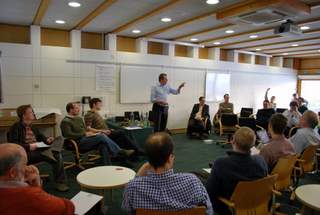
The newly-formed Open Innovation Research Forum (OIRF) held its inaugural meeting in the form of a two-day ‘fast start’ research proposal development workshop. The OIRF workshop – sponsored by the UK Innovation Research Centre and Japan’s Institute for Technology, Enterprise and Competitiveness – brought together 40 representatives of multinationals, open innovation intermediaries, and academics from around the world to discuss the links between geographic location and the successful implementation of open innovation. The workshop ran over two days and took an open approach to identifying the challenges and developing collaborative research proposals for addressing these challenges.
The first day was devoted to capturing the issues that companies feel are most important when trying to implement open innovation in different locations. The workshop kicked-off with four presentations to stimulate discussion. First, attendees were able to hear a summary of a recent UK-IRC survey that as captured the current open innovation practices of 1,200 UK firms. Next, the contrasting experiences of Kodak and Philips were presented, highlighting the role of location in their open innovation strategies. Finally, the role of open innovation in attracting investment to the UK was presented, with particular emphasis being given to the ‘Tech City’ development in London. Attendees then worked in groups to filter the wide range of issues raised by these discussions and select five key questions that, if addressed, would be of direct benefit to companies implementing open innovation and those that support them.
A dinner at King’s College then provided attendees with a chance to network and reflect on the day’s discussions.
The second day was structured around identifying ways in which the key questions identified by the companies on the first day could be addressed. This was done through a process of academics presenting a short, PowerPoint-free summary of their work and preferred research methods, and then matching these with the questions identified by the companies. Groups then spent the afternoon working on developing outline proposals for projects to address these questions. By the end of day, six outline proposals, each involving a minimum of two academic institutions, were developed and presented back to all attendees. The six proposals were:
1. Comparing open innovation best practices in developed countries versus emerging markets
2. Identifying factors influencing successful open innovation implementation
3. Open innovation for corporate growth and renewal
4. Effective intra- and inter-organisation collaborations
5. Developing leadership capabilities for open innovation
6. The role of open innovation in stimulating cluster development
Each of these proposals will now be taken forward and resources sought to run these collaborative projects. In addition, an edited book summarising current knowledge in the area of location and open innovation is being explored, and planning for the next OIRF meeting is already underway.
For further information on this workshop, the projects listed above, or any other matter relating to OIRF, please contact tim.minshall@eng.cam.ac.uk. The OIRF is coordinated by Cambridge University Engineering Department’s Institute for Manufacturing. Further information on the activities of OIRF will soon be published via www.oirf.net.
Open innovation in Japan: A noticeable change?
For the past 7 years, I have been visiting Japan each year to work with colleagues in Kyoto on various projects relating to the management ...
-
In my last post , the issue of how partnerships with start-ups could help large Japanese ICT firms cope with the fact that their industry is...
-
For the past 7 years, I have been visiting Japan each year to work with colleagues in Kyoto on various projects relating to the management ...
-
Just under three years ago, I gave a presentation on the impact of open innovation on the activities of firms within the Cambridge high tec...