Wednesday, September 16, 2015

Innovation Roundtable - discovering the 'adjacent possible' with emerging technologies

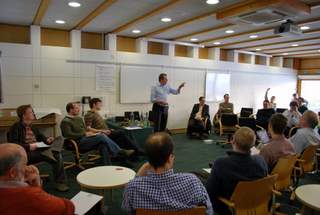
Earlier today I attended one of Axel Rosenø's Innovation Roundtable workshops, this one being on the topic of Technology Enabled Business Model Innovation. Others will do a much better job of summarising the wide range of themes presented and discussed during this event, but here are some brief personal selected highlights:
  • Shell:  We heard interesting examples of how start-ups are implementing business models in the world of transport, including Filld (fuel delivery service) and MetroMile (pay-per-mile insurance). During one of the many fruitful informal discussions, examples of interesting 'non-traditional' innovations from Shell emerged:  these included 'Fill Up and Go' and the trial of an app that used the sensors in drivers' smartphones to sense how they were driving, and reward economical behaviour with reward points.
  • Bosch: For IoT innovations in a firm such as Bosch, one challenge is bringing together and aligning the different worlds of what were described as the 'Machine guys' with the 'Internet guys'.  Bosch use a very structured process to explore IoT opportunities (solution sketches, mapping value drivers >value proposition >value delivery, stakeholder network diagrams etc.)
  • JLR:  Innovation in automotive has been largely incremental for many years. Disruption requires a catalyst, and one example of that is the explosion of mobile communication technologies, and the way in which these are now so deeply integrated into cars. Vehicles now contain a huge range of sophisticated ICT systems that are an innovation 'gift' for car makers to exploit. For example, JLR can now offer a range of features that are enabled by the connection between the car and the driver's smartphone.  
  • 3D printing: the discussions that followed the presentation of trends in 3D printing raised many common themes with those revealed during evidence gathering to support the development of UK national strategy for 3D printing. Key among these were concerns about the availability of data on the performance of different material / machine / process combinations. The discussions also highlighted the need for firms to be able to experiment with 3D printing technologies to help discover the 'adjacent possible' that could be the real opportunities for value capture from these technologies.
And on the actual logistics of the event, I like the use of Catchbox for Q&A from the floor and the IRMeet app for the use of in-presentation polls, stimulating discussions, and capturing feedback. 

Monday, September 14, 2015

New Research on "Open Innovation: A New Classification and its Impact on Firm Performance in Innovative SMEs"

This paper attempts to deepen understanding of the relationship between open innovation (OI) and firm performance in small and medium-sized enterprises (SMEs). Based on survey data from 306 Korean innovative SMEs, the results of this study show that: (1) broad and intensive engagement in OI and cooperation with external partners are positively associated with firm performance; (2) technology and market-oriented OI modes (Joint R&D, user involvement and open sourcing), involving relatively low level of changes, can positively contribute to performance enhancement; and (3) innovative SMEs benefit from working with non-competing partners, such as customers, consultancy/intermediaries and public research institutes. This work has broadened the evidence available on SMEs’ OI adoption and has proposed a new way to study OI adoption and implementation.
Click here to download full paper.

Sunday, September 13, 2015

2nd Annual World Open Innovation Conference


"The Garwood Center for Corporate Innovation, Haas School of Business, University of California, Berkeley, is pleased to announce its 2nd Annual World Open Innovation Conference. The 1st Annual World Open Innovation Conference was a “sold-out” event!
Engage with Open Innovation practitioners, and dialogue with world-renowned Open Innovation experts who share relevant research and expertise in their industry. Gain insight into the prospective value for both industry leaders and academic scholars. Learn how firms organize and incorporate Open Innovation services into their structure. National and international leading organizations will share their Open Innovation challenges with academic colleagues to foster stronger connections between business practice and academia. Academic scholars are invited to present their own research on the topic, and consider how their findings might improve and transform the performance of real organizations. One of the conference’s unique features is that it aims to address and bridge the gaps between academic research and the practical execution of Open Innovation. Join us at the World Open Innovation Conference for an opportunity to network and engage with Open Innovation practitioners."

Sunday, February 8, 2015

AstraZeneca coming to Cambridge: A sign of the times?

Earlier this week, planning permission was granted for AstraZeneca's new Global R&D Centre and Corporate Headquarters at the Cambridge Biomedical Campus.  The initial announcement of this plan in 2013 attracted great interest and excitement as it represented a major coup for the region. This seemed to show that Cambridge can not only build £bn companies on the back of its strengths in science and technology, but it can also attract significant direct corporate investment.
Several major corporations have had R&D facilities in Cambridge for many years (PhilipsRolls-RoyceMicrosoftNokia, to name a few) but the scale of the AstraZeneca facility - £330m investment, 2,000 employees - dwarfs many of the earlier investments by large organisations.
The site of the planned AstraZeneca facility at the
Cambridge Biomedical Campus

AstraZeneca states that it believes Cambridge will provide them with "[..] invaluable access to world-leading scientific expertise and provides excellent opportunities for collaboration with renowned academic research institutions, pre-eminent hospitals and cutting-edge biotech companies". This reflects a widespread trend towards more open models of innovation that draw upon the strengths of specific regional clusters. It also reflects a response to specific challenges facing the pharmaceutical industry, where massively increasing R&D spend has not been leading to 'blockbuster' successes in the market. Establishing R&D activities within a thriving regional innovation clusters is one way for firms to form and manage partnerships that allow them to share the risks (but also the rewards) of research commercialisation.

But there are some potential downsides to this move. There is something of a Catch-22 problem: people want to work and live in Cambridge because of the perceived high quality of life. But the sudden arrival of 2,000 new workers (plus dependents probably doubling that number) in a city with a population of 124,000 may start to put strains on the infrastructure (especially transport and housing), thus lowering the very quality of life that made the move attractive in the first place.

As the Cambridge Technopole continues to build upon its success with more successful start-ups and more inwards investment (most recently from Apple and Amazon), the importance of the joined-up long-term strategy for the city's development within the wider region becomes ever more important.

Sunday, January 4, 2015

1st Annual World Open Innovation Conference 4-5 December 2014

The 1st Annual World Open Innovation Conference in Napa was held in early December last year, run by the ‘Founding Father' of Open Innovation, Henry Chesbrough with Wim Vanhaverbeke, Joel West and Frank Piller. The event brought together a broad range academics and industrialists to discuss emerging trends in open innovation research and practice. It was also an opportunity to make connections between open innovation and longer established academic domains such as dynamic capabilities and knowledge management through the presence of David Teece and Ikujiro Nonaka.  

One interesting theme that was noted at several points in the conference was link between the ‘maker’ movement, 3D printing, and open innovation. This message was reinforced by the announcement at the conference of the new strategic alliance between TechShop and Fujitsu’s open innovation activities.

A detailed summary of the day 1 and day 2 activities can be read on Joel West's open innovation blog, and there is also a slideshow on YouTube of themes discussed at the conference. 


The event also served as an informal launch event for the latest book edited book by Chesbrough, Vanhaverbeke and West on “New Frontiers in Open Innovation”.

Sunday, January 27, 2013

Is 'open' now redundant?


Just under three years ago, I gave a presentation on the impact of open innovation on the activities of firms within the Cambridge high tech business cluster.  In that talk, I made a throwaway comment about whether we'd one day be able to drop the 'open' bit and just go back to talking about 'innovation'.  Last week, as I was summing up the key learning points from a module on Technology and Innovation Management for some of our MEng students, the same thought struck me again.  As I drew together the key points from each of the sessions we'd covered during the week (the timetable is shown below), almost every theme we covered had 'open' aspects to it. With hindsight  it felt a little bit as though having a session explicitly on open innovation was now a bit redundant.  But I'm not sure whether this is just a bit of Maslow's hammer in my thinking (i.e. I just see open innovation everywhere because that's how I see the world), or whether we really should be thinking - and teaching - less about specific flavours of innovation, and more about appropriate tools for different tasks.

Sunday, February 12, 2012

Start with open questions: How Cambridge academics are learning the skills of open innovation

Many large corporations talk of transforming themselves to embrace open innovation, and opening up to external ideas.  But grand strategic statements and new corporate PowerPoint slides do not change the capabilities of an organisation.  The implementation of a more open approach rests also on the development of specific skills among individual employees. Research has identified what some of these skills are, and shown that these can be internally developed or accessed via various intermediary organisations.  Much of this research on open innovation has focused on the ways in which corporations - predominantly large multinationals -  have transformed themselves, or are attempting to do so.  However, there is much less discussion on the ways in which one particular type of open innovation partner - universities - also need to develop new capabilities.


Since the late 1990s, UK universities have been explicitly encouraged - and funded - by the Government to develop their 'third missions', i.e. adding 'application' to their traditional two missions of teaching and research. Public funding for universities is now explicitly linked, in part, to their ability to demonstrate the 'impact' of their research activities.  One way of helping ensure that research is more impactful is through the engagement of corporate partners throughout the research process, as funders, collaborators and end-users. Or, to put it another way, universities are now positioning themselves as open innovation partners for corporations.

Many universities have set up dedicated groups to help smooth interactions with industry partners, but what has received much less attention is the need to help academics themselves develop the skills needed to identify, negotiate, setup and manage projects that deliver mutual benefit. Though there is an essential role to be played by university research offices, technology transfer, and corporate liaison offices, as successful technology entrepreneurs know, engaging with customers is something that everyone in the organisation needs to be good at.   Recognising this, Cambridge University Computer Lab and the Engineering Department recently ran a workshop to help academics develop their skills for setting up industrial collaborations.


The workshop was delivered by a former Cambridge Engineering Department researcher, who has gone on to run several successful manufacturing and service businesses across Europe:  getting an engineer to run the workshop helped avoid some of the Dilbert-esque concerns that might have turned-off potential attendees. 38 academics from across the School of Technology signed up to spend a day learning about the process of identifying and working with potential commercial partners to develop collaborative research activities.    Basic negotiation and sales skills were introduced, and delegates then spent the bulk of the day practicing these skills through the delivery of elevator pitches and the series of structured role-plays.

One workshop alone will not make a huge difference to the culture and operations of a university.  But by showing how partnerships with industry can result in the identification and resourcing of relevant and exciting research topics, and giving people the skills to develop such partnerships, events like this are an important step in the development of universities as useful open innovation partners.

Open innovation in Japan: A noticeable change?

For the past 7 years, I have been visiting Japan each year to work with colleagues in Kyoto on various projects relating to the management ...